
AI Code Generation: Overview, Risks, and Challenges

AI code generation relies on machine learning and natural language processing to automatically generate code. It is such a broad definition and can imply anything from simple autocompletion to fully autonomous development.
Other common synonyms for "AI code generation" in use today are:
- Vibe coding - Coined by Andrej Karpathy, but my least favorite term. Describes a high-level approach where a developer provides natural language "vibes" or intent, and the AI handles the implementation without the user needing to touch the syntax.
- Agentic development - Refers to using autonomous AI agents that don't just write snippets, but can plan, execute, test, and debug multi-file changes across an entire repository independently.
- AI-assisted programming - A broad, professional term for a collaborative workflow where a human developer remains the primary pilot while using AI to accelerate routine tasks like boilerplate or refactoring.
- Prompt-to-code - Not a commonly used term but recently referred to as NLP-Dev (Natural Language Programming-Development). Describes the specific technical act of translating a human-language description directly into executable source code.
- Autonomous coding - My specific area of interest. Minimal to zero human intervention needed here.
I may use many of these terms interchangeably, but in the end, they all mean the same thing, which is to leverage natural language prompting to assist in code creation with little to no human intervention.
Below you'll get a simple and generic overview of AI code generation, but my initial intent of this post was to highlight some of the risks (and possible mitigations) of over-reliance on AI code generation. Read on...
Why use AI code generation?
If not obvious already, some of the benefits of AI code generation include:
- Enables developers to generate code faster
- Accelerates debugging and troubleshooting
- Boosts developer productivity
- Rapid experimentation
- Quickly and efficiently test and debug code
- Reduces the work of manually writing lines of code
- Alleviates developer’s mental load and reduces burnout
- Frees developers to focus on higher-value work
- Makes code development accessible to non-developers
Rapid experimentation and accelerating development seem to be the top two benefits often cited.
How does AI code generation work?
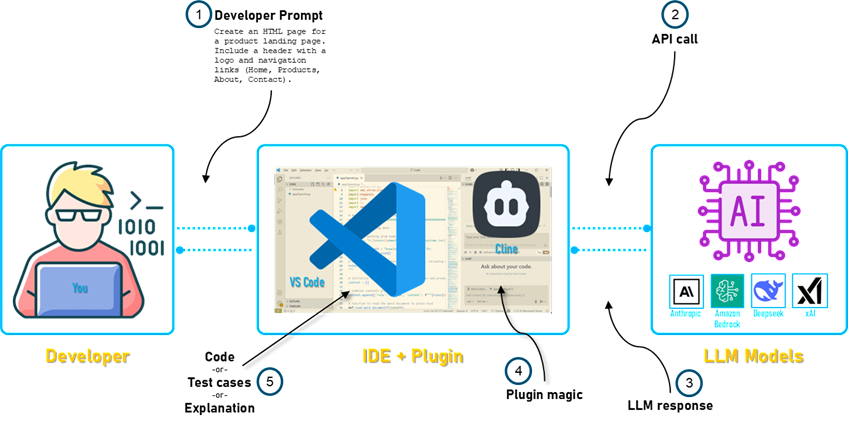
The following diagram provides a simple explanation of how AI code generation works.
First, the developer enters a prompt using natural language to a plugin within the IDE. This could be a simple "Create an HTML-based calculator application." The plugin makes an API call to a provider's model (you choose the provider and model), usually at a cost per call. The response is returned by the model. The response could be informational or instruct the plugin to begin manipulating your local code for you (i.e., operating as an "agent").
What are some risks and challenges of AI code generation?
- Low quality code - Hallucinations, lack of consistency, and poor coding standards can be experienced. Repeated attempts for the agent to fix code can be unsuccessful.
- Security vulnerabilities - Data poisoning is a real problem. For example, there are over 1 billion repos in GitHub, 278 million of them public. No doubt that a significant number of these repos have malicious code intentionally embedded within them with serious vulnerabilities so that unsuspecting folks are compromised when they download and execute the code. Now imagine GitHub Copilot being trained on this code.
- Data privacy - Your code and data could be used for model training, particularly if you are not on a paid business or enterprise plan.
- Licensing & copyright risks - The model could potentially include open-source code without attribution. This is all new territory and implications within the industry are yet to be seen.
- Cost - The more calls that are made through continuous prompting by the developer, the larger your code set, and the higher quality the model you are using, then expect more $$$ required. Food for thought: If it takes 10 seconds to generate code but 20 minutes to verify it, was it actually faster/cheaper?
- Speed - Complex tasks on certain models can take considerable time (50+ minutes for a single request) and still be riddled with bugs.
- Risk of technical debt - Can create long-term maintenance challenges due to poorly structured or inconsistent implementation.
- Skills atrophy - Coding skills of developers can erode over time.
- Loss of developer control - Too much developer dependency on AI can contribute to reduced understanding of codebase.
How do you mitigate some of the risks of AI code generation?
Taking each of the risks from the previous section, here are some approaches to mitigate each of those risks.
- Low quality code –> Always review AI generated code.
- Security vulnerabilities –> Enforce mandatory scanning of your code with SAST tools within your pipelines.
- Data privacy –> Consider self-hosted AI coding assistants and/or verify vendor’s policies. Always read the fine print.
- Licensing & copyright risks –> Run generated code through license scanners and/or verify vendor’s policies. Some vendors (e.g., Microsoft for GitHub Copilot) include indemnification clauses in their upper tiered plans. GitHub Copilot also has an "exclusion" filter to prevent the AI from suggestion code that matches public repositories.
- Cost –> Consider lower cost models (e.g., Claude Sonet 4.6 versus Claude Opus 4.6; see my other post on this here).
- Speed –> Consider models that emphasize speed over quality for non-complex scenarios (e.g., front-end stuff) (see my other post on this here).
- Risk of technical debt –> If you have bandwidth restrictions to perform code reviews, consider automated static code analysis tools.
- Skills atrophy - Developers should periodically implement components or modules manually and conduct design reviews.
- Loss of developer control –> Mandate that AI-generated code be treated as a draft and thus requires developer validation first, ensuring that it aligns with the overarching architecture. This is easier said than done though.
The reality is, there is no single tool that stops AI risk. Leveraging layered defense, implement SAST (for the code), SCA (for the libraries), and a human (for the logic).
One of my fears of modern AI and autonomous code generation is that it may eventually create a generation of Copy-Paste Developers who can't debug the foundations of their own code.